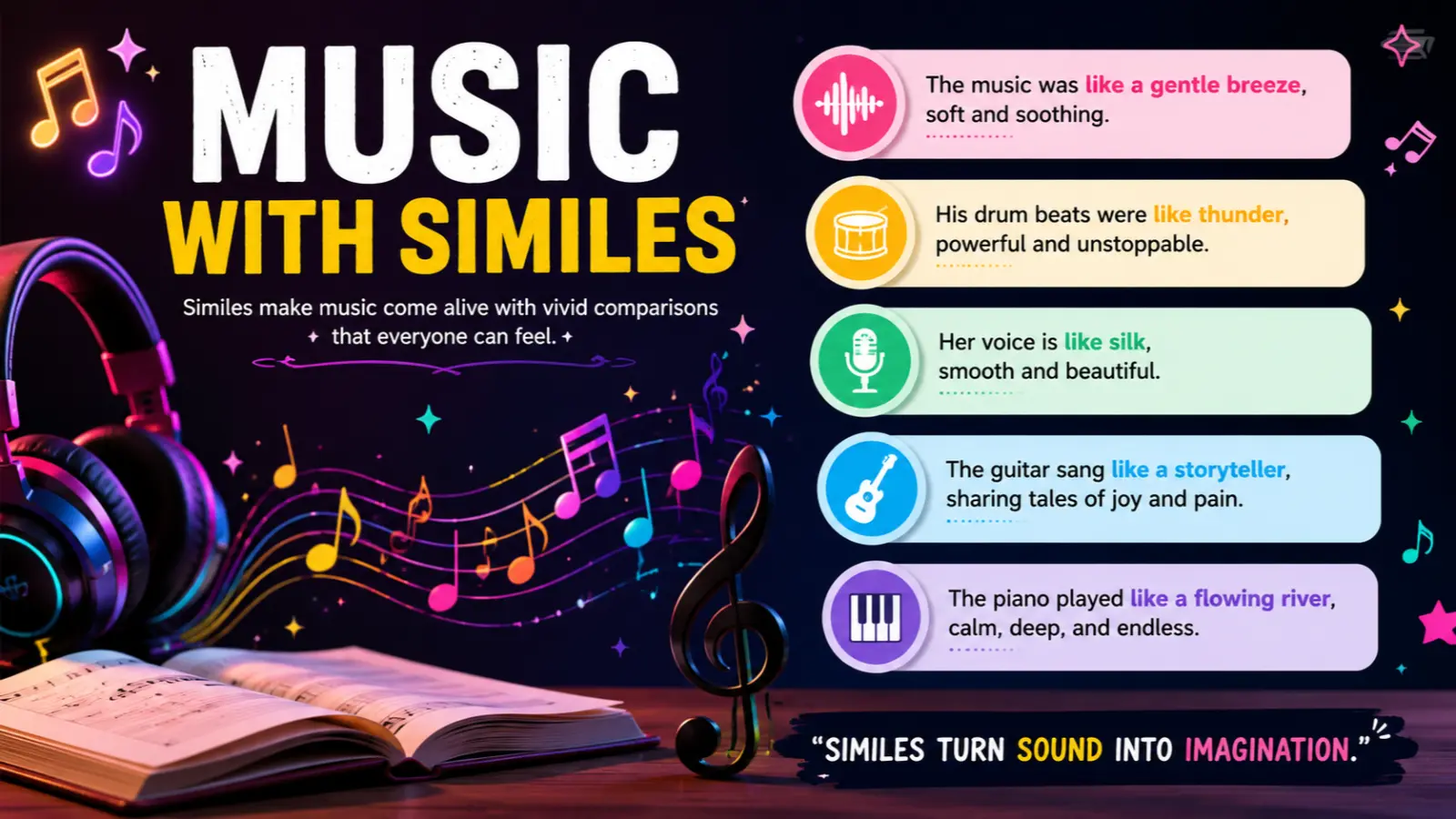
Music has a unique way of expressing emotions that ordinary words often cannot. Whether you’re writing a novel, poem, song, speech, or school assignment, similes can help readers hear, feel, and imagine music more vividly.
A simile compares two different things using words like “as” or “like.” Instead of simply saying music was beautiful, you can compare it to something familiar that creates a stronger mental image.
In this guide, you’ll discover original music with similes, learn why they work, see them used in different types of writing, and pick up techniques that make your own descriptions more memorable.
What Are Music Similes?
Music similes compare music, sound, singing, instruments, or rhythm to something else using like or as.
They help readers imagine:
- Tone
- Volume
- Rhythm
- Emotion
- Atmosphere
- Movement
Instead of telling readers what music sounds like, a good simile lets them experience it.
Why Writers Use Similes in Music
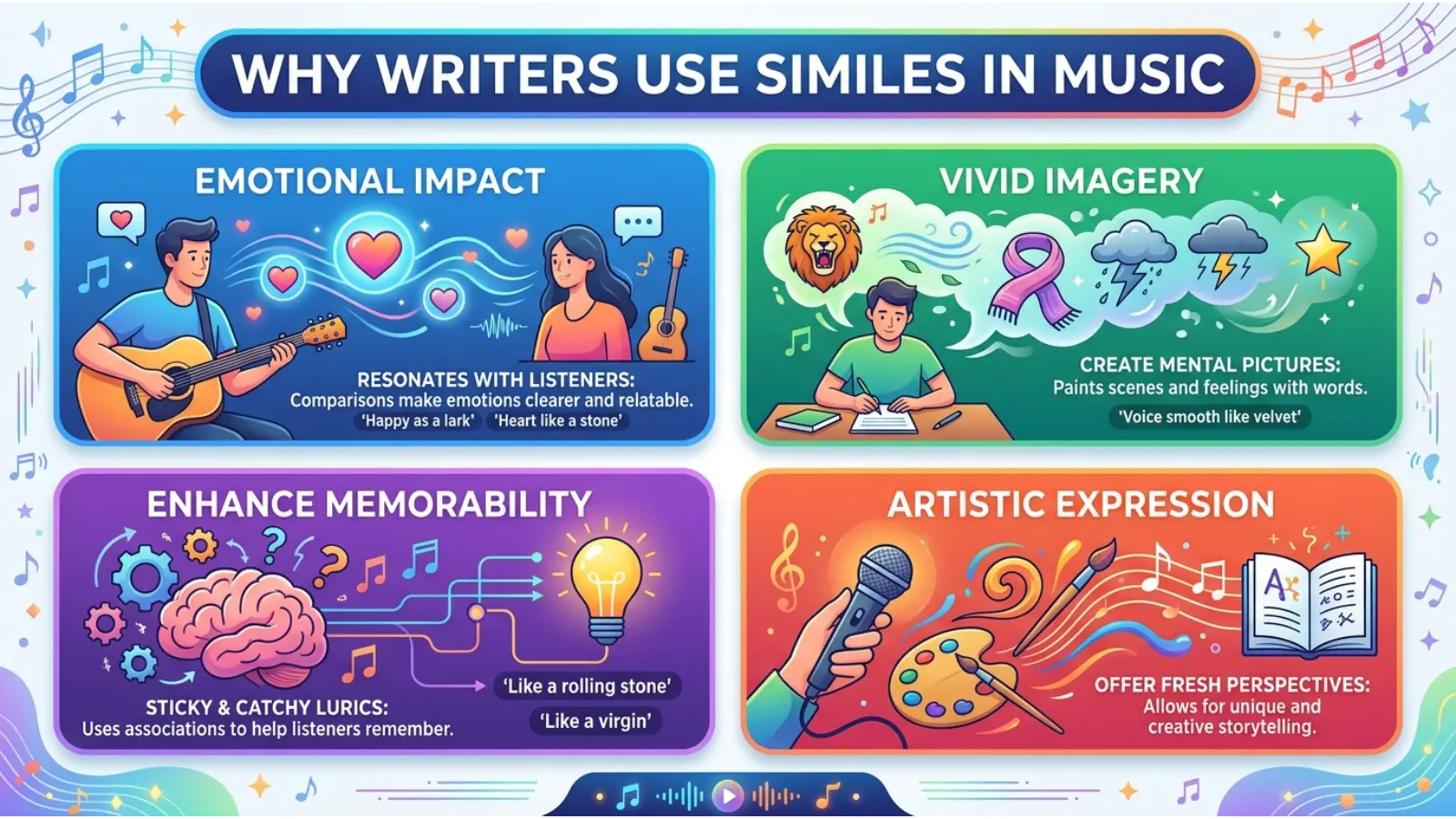
Music is invisible. Readers cannot literally hear words on a page.
Similes bridge that gap by connecting sound to familiar experiences.
Good music similes can:
- Build emotional scenes
- Add personality to songs
- Strengthen poetry
- Improve storytelling
- Make descriptions more cinematic
30 Original Music Similes
1. Music floated like lanterns across a quiet lake.
Meaning
The music felt peaceful, gentle, and calming.
Example Sentences
- The violin music floated like lanterns across a quiet lake.
- Soft piano notes drifted through the room like lanterns at night.
Writing Tip
Perfect for peaceful scenes.
2. Her voice sparkled like morning frost.
Meaning
The singing sounded bright and fresh.
Examples
- Her voice sparkled like morning frost during the chorus.
- Every high note shimmered like fresh ice.
Best Context
Pop music, choir performances, fairy tales.
3. The drumbeat marched like determined footsteps.
Meaning
Strong rhythm with confidence.
Conversation
“The beat marched like determined footsteps.”
Storytelling
The soldiers advanced while the drums marched beside them.
4. The melody curled like smoke through the room.
Meaning
Smooth, flowing music.
Poetry
The melody curled like silver smoke around silent hearts.
5. Music burst like sunlight through clouds.
Meaning
Sudden happiness and hope.
Formal Example
The orchestra’s finale burst like sunlight through heavy clouds.
6. His guitar sang like a lonely traveler.
Meaning
Emotional and reflective.
Writing Purpose
Excellent for emotional scenes.
7. The chorus bloomed like spring flowers.
Meaning
Gradually becoming fuller and brighter.
Examples
- The chorus bloomed like spring flowers.
- Every harmony opened beautifully.
8. The violin whispered like falling snow.
Meaning
Very soft, delicate music.
Poetry
Its strings whispered like falling snow beneath the moon.
9. The trumpet shined like polished gold.
Meaning
Powerful and brilliant.
Storytelling
The trumpet shined like polished gold above the orchestra.
10. The rhythm rolled like ocean waves.
Meaning
Steady, repeating motion.
Writing Tip
Ideal for describing relaxing music.
11. Piano notes danced like playful butterflies.
Meaning
Light, joyful movement.
Examples
Tiny notes danced across the keys like butterflies.
12. Music wrapped around us like a warm blanket.
Meaning
Comforting and safe.
Conversation
“This song wraps around you like a warm blanket.”
13. The singer’s voice rose like an eagle.
Meaning
Powerful, soaring vocals.
Best Context
Concert reviews.
14. The melody glowed like candlelight.
Meaning
Warm, intimate feeling.
Poetry
A melody glowed like candlelight inside forgotten memories.
15. The bass rumbled like distant thunder.
Meaning
Deep, powerful sound.
Examples
The bass echoed like thunder beneath our feet.
16. Music flowed like a winding river.
Meaning
Smooth, continuous movement.
Writing Tip
Works well for instrumental music.
17. The chorus soared like birds at sunrise.
Meaning
Freedom and hope.
Storytelling
Voices soared like birds greeting dawn.
18. The notes scattered like autumn leaves.
Meaning
Gentle, unpredictable movement.
Emotional Effect
Creates peaceful imagery.
19. The melody shimmered like stars after rain.
Meaning
Beautiful and magical.
Formal Example
The solo shimmered like stars after rain.
20. Music echoed like laughter in old halls.
Meaning
Warm memories and nostalgia.
Conversation
“The song echoed like childhood laughter.”
21. The flute drifted like a cool breeze.
Meaning
Refreshing and gentle.
Poetry
Its sound drifted like a breeze through green fields.
22. The rhythm leaped like a playful dolphin.
Meaning
Energetic and lively.
Best Context
Dance music.
23. The choir rose like mist at dawn.
Meaning
Gradual beauty and elegance.
24. Guitar strings shimmered like moonlight on glass.
Meaning
Bright yet delicate.
25. Music bloomed like fireworks in the night sky.
Meaning
Exciting emotional climax.
26. The harmony settled like fresh snow.
Meaning
Peaceful ending.
27. The song fluttered like colorful ribbons in the wind.
Meaning
Lighthearted and cheerful.
28. The melody climbed like ivy up an old wall.
Meaning
Slow, graceful growth.
29. The chorus sparkled like diamonds in sunlight.
Meaning
Brilliant and unforgettable.
30. The final note lingered like the last glow of sunset.
Meaning
A beautiful ending that stays with the listener.
Storytelling
The final note lingered like the last glow of sunset long after the audience stopped clapping.
What Makes a Music Simile Effective?
Strong music similes do more than compare sounds.
They also create:
- Emotion
- Movement
- Atmosphere
- Color
- Memory
Instead of comparing music to another sound, compare it to something readers can easily picture or feel. Images from nature, light, weather, seasons, and everyday life often produce stronger descriptions than generic comparisons.
How Professional Writers Create Musical Imagery
Experienced writers rarely stop at describing loud or quiet sounds. They focus on the emotional experience behind the music.
Ask yourself:
- Does the music comfort or disturb?
- Is it smooth or jagged?
- Does it rise, fall, swirl, or crash?
- What visual image matches that feeling?
The answers often lead to fresh, memorable similes.
Related Literary Devices
Metaphor
A metaphor states one thing is another without using “like” or “as.”
Simile: The melody flowed like a river.
Metaphor: The melody was a river.
Imagery
Imagery appeals to the senses. Pairing similes with vivid imagery helps readers almost hear the music.
Personification
Giving music human qualities adds personality.
Example:
The melody welcomed everyone into the room.
Hyperbole
Hyperbole exaggerates for effect.
Example:
The concert was loud enough to wake the mountains.
Alliteration
Repeating consonant sounds can mimic musical rhythm.
Example:
Soft strings sang sweetly.
Symbolism
Music can symbolize hope, freedom, celebration, grief, or remembrance. A well-chosen simile can reinforce these symbolic meanings.
Create Your Own Music Similes
You don’t need to wait for inspiration. Follow this simple process:
Step 1: Identify the feeling.
Is the music joyful, sad, energetic, mysterious, or peaceful?
Step 2: Think visually.
Choose something people can easily imagine, such as waves, birds, stars, smoke, rain, glass, or fireflies.
Step 3: Connect them naturally.
Example:
- Joyful music → like birds greeting sunrise
- Gentle melody → like leaves floating downstream
Practice Exercise
Write one simile for each type of music:
- A happy song
- A sad piano solo
- A loud rock concert
- A peaceful lullaby
- A dramatic movie soundtrack
Then revise each one by replacing any common comparison with a more surprising but believable image.
Common Mistakes When Writing Music Similes
Using Overused Comparisons
Phrases like sweet as honey or soft as a feather often feel predictable. Look for fresh images that fit the mood.
Mixing Imagery
Avoid combining unrelated comparisons in the same sentence.
Weak: The melody floated like a cloud and exploded like lightning.
Choose one clear image unless the music genuinely changes.
Forcing the Comparison
If the comparison feels unnatural, readers will notice. Every simile should strengthen the description, not distract from it.
Confusing Similes with Metaphors
Remember:
- Simile: uses like or as
- Metaphor: makes a direct comparison without those words.
Describing Without Purpose
Every simile should reveal something about the music—its emotion, rhythm, atmosphere, or impact on listeners.
Frequently Asked Questions
What is a simile in music?
A music simile compares a song, melody, rhythm, voice, or instrument to something else using like or as to create vivid imagery.
Why are similes useful when describing music?
They help readers imagine sounds, emotions, and movement that can’t be heard directly from written words.
Can songwriters use similes?
Yes. Songwriters often use similes to make lyrics more emotional, memorable, and relatable.
What’s the difference between a music simile and a metaphor?
A simile uses like or as, while a metaphor makes a direct comparison without those words.
How can I avoid cliché music similes?
Start with the emotion you want to express, then compare it to a fresh image from nature, everyday life, light, weather, or movement instead of relying on familiar expressions.
Are music similes good for poetry?
Absolutely. They add rhythm, imagery, and emotional depth, helping readers visualize and feel the music within a poem.
Conclusion
Music speaks to the heart, but similes help it come alive on the page. By comparing melodies, rhythms, and voices to vivid images from everyday life and nature, you can turn ordinary descriptions into memorable writing. As you experiment, focus on the emotion behind the sound rather than searching for flashy comparisons. The most effective music similes are the ones that feel natural, reveal something meaningful, and invite readers to hear the scene through your words.
I am Helena Frost, a writer captivated by the beauty of language and the art of comparison. Through my words, I explore the world by turning ordinary moments into vivid similes and reflections. I enjoy crafting phrases that spark imagination, evoke emotion, and linger in the mind. My writing celebrates the subtle connections between people, nature, and the stories we live. For me, every sentence is an opportunity to reveal the extraordinary in the everyday.