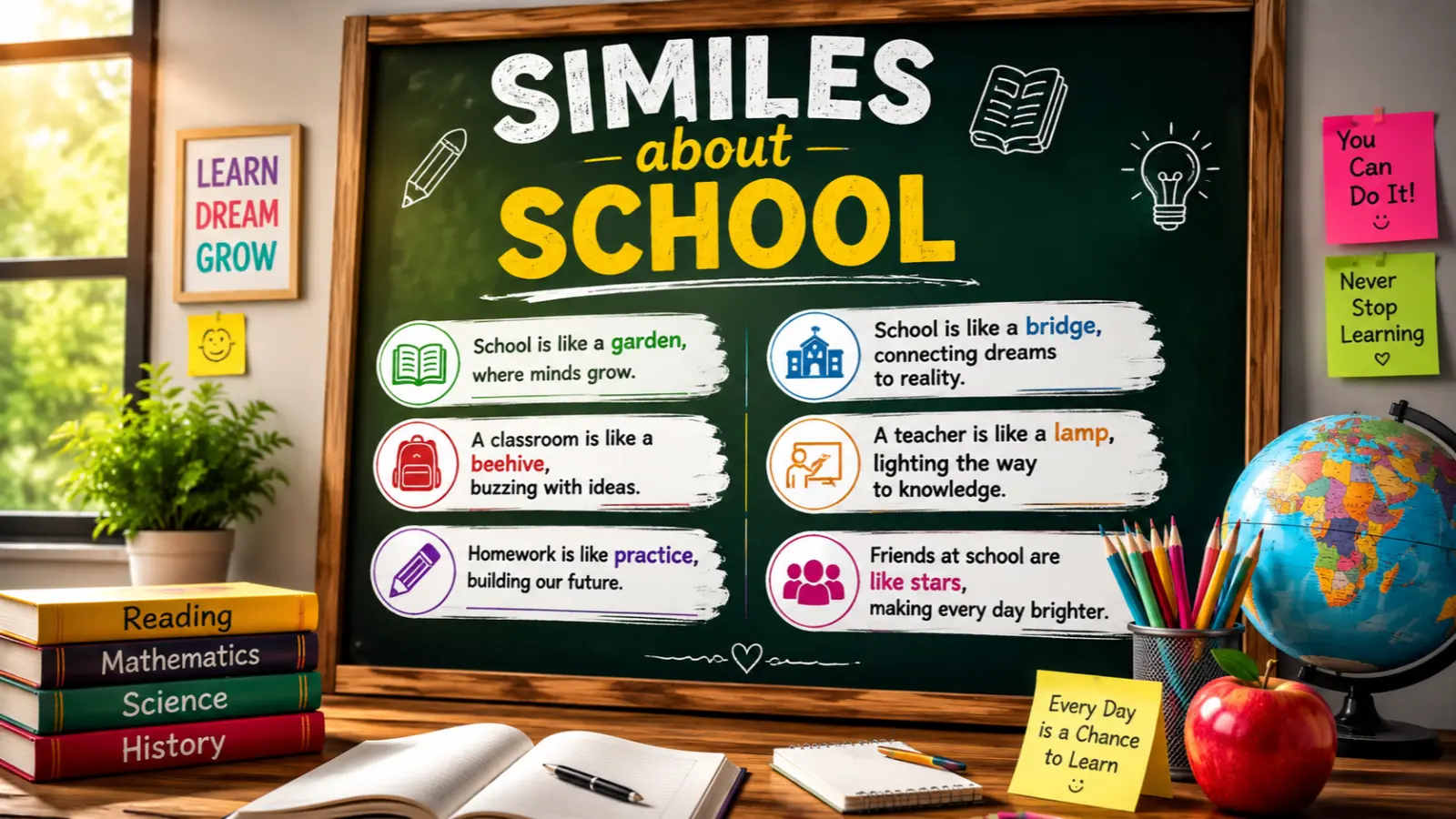
Similes About School is more than a place where students learn facts. It is where friendships grow, challenges appear, confidence develops, and memories are made. Writers often use similes to capture these experiences in colorful, memorable ways.
A simile compares two different things using the words “like” or “as.” Instead of simply saying someone is nervous, a writer might say, “He was as tense as a violin string before the test.” The comparison helps readers picture and feel the moment.
In this guide, you’ll discover original similes about school, learn why they work, see them in real examples, and pick up practical writing techniques you can use in essays, stories, poems, and classroom assignments.
Quick Answer
Similes about school compare people, classrooms, learning, teachers, emotions, or school life to familiar objects or experiences using “like” or “as.” They make writing more descriptive, relatable, and emotionally engaging by helping readers visualize everyday school moments.
Why Writers Use Similes About School
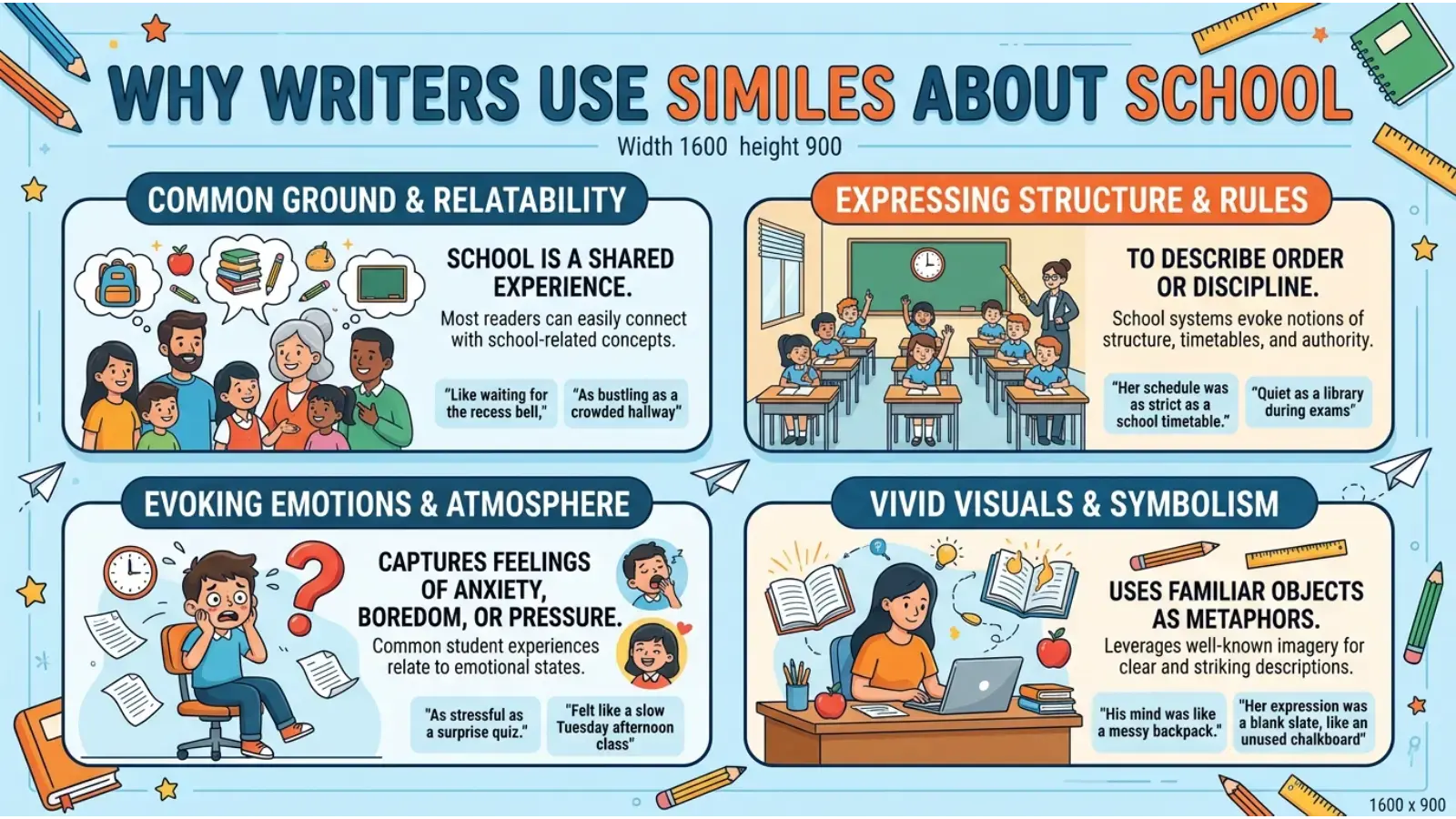
School is full of emotions.
A student might feel excited on the first day, nervous before an exam, proud after earning a good grade, or exhausted after a long week. Similes transform these ordinary experiences into vivid images that readers instantly understand.
They are especially useful in:
- Personal essays
- Creative writing
- Children’s stories
- Classroom assignments
- Poetry
- School speeches
- Journal writing
35 Original Similes About School
1. As welcoming as an open library
Meaning: A friendly, comfortable place.
Examples
- Our classroom felt as welcoming as an open library.
- Her smile made the new student feel as welcoming as an open library.
Writing Tip: Great for describing positive learning environments.
2. Like a backpack full of possibilities
Meaning: Filled with opportunities.
Examples
- The new school year felt like a backpack full of possibilities.
- Every lesson was like a backpack full of possibilities.
Best Context: First-day stories and motivational writing.
3. As busy as pencils before an exam
Meaning: Extremely active.
Examples
- The classroom became as busy as pencils before an exam.
- Students were as busy as pencils before an exam.
4. Like sunlight through classroom windows
Meaning: Bringing hope and positivity.
Examples
- Her encouragement spread like sunlight through classroom windows.
- The teacher’s words felt like sunlight through classroom windows.
5. As steady as a teacher’s morning routine
Meaning: Reliable and dependable.
Examples
- She remained as steady as a teacher’s morning routine.
- His study habits were as steady as a teacher’s morning routine.
6. Like chalk drawing a fresh beginning
Meaning: Representing a new start.
Examples
- Monday felt like chalk drawing a fresh beginning.
- The semester arrived like chalk drawing a fresh beginning.
7. As quiet as notebooks after the bell
Meaning: Completely silent.
Examples
- The hallway became as quiet as notebooks after the bell.
- The room stayed as quiet as notebooks after the bell.
8. Like curiosity climbing stairs
Meaning: Growing excitement to learn.
Examples
- Questions spread like curiosity climbing stairs.
- His imagination moved like curiosity climbing stairs.
9. As bright as fresh ideas on a whiteboard
Meaning: Creative and inspiring.
Examples
- Their project was as bright as fresh ideas on a whiteboard.
- Her presentation felt as bright as fresh ideas on a whiteboard.
10. Like pages turning in the wind
Meaning: Fast-moving learning.
Examples
- The school day passed like pages turning in the wind.
- Lessons flowed like pages turning in the wind.
11. As organized as labeled folders
Meaning: Neat and well-planned.
Examples
- His desk stayed as organized as labeled folders.
- The teacher remained as organized as labeled folders.
12. Like a bell calling everyone together
Meaning: Bringing people together.
Examples
- Her announcement spread like a bell calling everyone together.
- Teamwork arrived like a bell calling everyone together.
13. As colorful as classroom artwork
Meaning: Full of creativity.
Examples
- The hallway looked as colorful as classroom artwork.
- Their ideas became as colorful as classroom artwork.
14. Like answers appearing after patience
Meaning: Success through persistence.
Examples
- Understanding came like answers appearing after patience.
- Confidence arrived like answers appearing after patience.
15. As determined as a student chasing a dream
Meaning: Highly motivated.
Examples
- She stayed as determined as a student chasing a dream.
- He practiced as determined as a student chasing a dream.
16. Like a ruler keeping every line straight
Meaning: Orderly and disciplined.
Examples
- The teacher guided the class like a ruler keeping every line straight.
- The project stayed like a ruler keeping every line straight.
17. As lively as recess on a sunny day
Meaning: Energetic and joyful.
Examples
- The playground was as lively as recess on a sunny day.
- The students laughed as lively as recess on a sunny day.
18. Like a notebook waiting for stories
Meaning: Full of potential.
Examples
- The semester felt like a notebook waiting for stories.
- Every assignment looked like a notebook waiting for stories.
19. As focused as eyes on the blackboard
Meaning: Paying close attention.
Examples
- The class became as focused as eyes on the blackboard.
- She listened as focused as eyes on the blackboard.
20. Like stepping stones across knowledge
Meaning: Gradual progress.
Examples
- Each lesson became like stepping stones across knowledge.
- Homework worked like stepping stones across knowledge.
21. As patient as a teacher explaining twice
Meaning: Very patient.
Examples
- She was as patient as a teacher explaining twice.
- He answered questions as patient as a teacher explaining twice.
22. Like crayons filling an empty page
Meaning: Bringing creativity.
Examples
- New ideas spread like crayons filling an empty page.
- The art lesson bloomed like crayons filling an empty page.
23. As strong as teamwork during a project
Meaning: United and cooperative.
Examples
- Their friendship became as strong as teamwork during a project.
- The class worked as strong as teamwork during a project.
24. Like a question searching for an answer
Meaning: Curious and thoughtful.
Examples
- Her mind wandered like a question searching for an answer.
- The mystery grew like a question searching for an answer.
25. As cheerful as the last school bell on Friday
Meaning: Extremely happy.
Examples
- Everyone felt as cheerful as the last school bell on Friday.
- She smiled as cheerful as the last school bell on Friday.
26. Like a compass pointing toward success
Meaning: Providing guidance.
Examples
- The teacher acted like a compass pointing toward success.
- Good advice worked like a compass pointing toward success.
27. As calm as an empty classroom at dawn
Meaning: Peaceful.
Examples
- The building was as calm as an empty classroom at dawn.
- She remained as calm as an empty classroom at dawn.
28. Like building blocks becoming a castle
Meaning: Small efforts creating something great.
Examples
- Daily practice grew like building blocks becoming a castle.
- Knowledge expanded like building blocks becoming a castle.
29. As sharp as a freshly sharpened pencil
Meaning: Intelligent and alert.
Examples
- His thinking was as sharp as a freshly sharpened pencil.
- She stayed as sharp as a freshly sharpened pencil.
30. Like a map leading toward discovery
Meaning: Showing the way.
Examples
- The lesson felt like a map leading toward discovery.
- Reading became like a map leading toward discovery.
31. As encouraging as applause after a presentation
Meaning: Supportive.
Examples
- Her words were as encouraging as applause after a presentation.
- The teacher’s feedback felt as encouraging as applause after a presentation.
32. Like seeds growing into knowledge
Meaning: Learning develops over time.
Examples
- Ideas grew like seeds growing into knowledge.
- Every book worked like seeds growing into knowledge.
33. As confident as a student with every answer
Meaning: Self-assured.
Examples
- He walked as confident as a student with every answer.
- She spoke as confident as a student with every answer.
34. Like doors opening to new adventures
Meaning: Beginning exciting opportunities.
Examples
- Graduation felt like doors opening to new adventures.
- Education became like doors opening to new adventures.
35. As unforgettable as the first day of school
Meaning: Memorable.
Examples
- The experience was as unforgettable as the first day of school.
- Their achievement remained as unforgettable as the first day of school.
How to Write Better School Similes
Strong similes come from observation rather than imitation.
Instead of comparing everything to common objects like stars or flowers, think about real school experiences. Notice the sounds of the hallway, the smell of new books, the excitement before recess, or the silence during a test.
A memorable comparison often connects an emotion with a familiar classroom experience.
For example, instead of writing:
“She was happy like the sun.”
Try:
“She smiled like a student hearing the final bell before summer break.”
The second comparison creates a stronger emotional picture because readers recognize the experience.
Why These Similes Work
Effective school similes succeed because they:
- Connect with everyday experiences.
- Create clear mental images.
- Express emotions naturally.
- Fit stories, essays, and poems.
- Feel original without sounding strange.
Readers remember comparisons that are believable and specific.
Related Literary Devices
Metaphor
A metaphor compares two things without using like or as.
Simile: The classroom was like a beehive.
Metaphor: The classroom was a beehive.
Imagery
Imagery uses sensory details to help readers see, hear, smell, taste, or feel a scene.
Similes strengthen imagery by making descriptions more vivid.
Personification
Personification gives human qualities to non-human things.
Example:
“The school bell sang across the hallway.”
Hyperbole
Hyperbole uses deliberate exaggeration.
Example:
“Homework was as tall as a mountain.”
Symbolism
Certain school objects can represent larger ideas.
- Books symbolize knowledge.
- Keys symbolize opportunity.
- Graduation caps symbolize achievement.
- Classrooms symbolize growth.
Create Your Own School Similes
Follow these simple steps:
Step 1
Choose one school subject or object.
Examples:
- Backpack
- Bell
- Teacher
- Notebook
- Playground
- Library
Step 2
Choose an emotion.
Examples:
- Joy
- Fear
- Curiosity
- Pride
- Hope
- Excitement
Step 3
Think of something that shares the same quality.
Step 4
Combine them using like or as.
Example:
“My excitement was like a backpack packed for the first day of school.”
Creative Exercise
Write five similes about:
- Your favorite class
- A school trip
- A science experiment
- A difficult exam
- Your best friend at school
Then replace one ordinary adjective in each sentence with a fresh simile.
Common Mistakes to Avoid
Using Overused Comparisons
Avoid familiar comparisons that readers have seen countless times.
Look for fresh, believable images from real school life.
Mixing Imagery
Stay with one clear comparison instead of combining unrelated images.
Confusing Similes and Metaphors
Remember:
- Similes use like or as.
- Metaphors do not.
Forcing Comparisons
If a comparison feels unnatural, simplify it.
The best similes sound effortless.
Choosing Weak Descriptions
A simile should reveal something meaningful, not simply decorate a sentence.
Frequently Asked Questions
What are similes about school?
They are comparisons using like or as to describe school experiences, students, teachers, classrooms, or learning.
Why should students use similes in writing?
They make descriptions more vivid, memorable, and engaging while improving creative expression.
Can I use school similes in essays?
Yes. They work well in narrative essays, personal reflections, and creative assignments when used naturally.
What’s the difference between a school simile and a metaphor?
A simile uses like or as, while a metaphor makes a direct comparison without those words.
How many similes should I use in one paragraph?
Usually one or two strong similes are enough. Too many can distract readers.
Are original similes better than common ones?
Yes. Original comparisons make your writing stand out and create stronger imagery.
Can children write their own school similes?
Absolutely. Starting with familiar classroom experiences makes it easier to create creative and meaningful comparisons.
Conclusion
School offers endless inspiration for creative writing because it is filled with learning, emotions, friendships, and unforgettable moments. Original similes help transform these everyday experiences into vivid images that readers can easily picture and remember. As you write, focus on real observations rather than familiar comparisons. Notice the sounds, routines, and emotions that make school unique, then connect them with fresh, meaningful imagery. With practice, your similes will become more natural, expressive, and memorable, making every story, poem, or essay more enjoyable to read.

I am Helena Frost, a writer captivated by the beauty of language and the art of comparison. Through my words, I explore the world by turning ordinary moments into vivid similes and reflections. I enjoy crafting phrases that spark imagination, evoke emotion, and linger in the mind. My writing celebrates the subtle connections between people, nature, and the stories we live. For me, every sentence is an opportunity to reveal the extraordinary in the everyday.