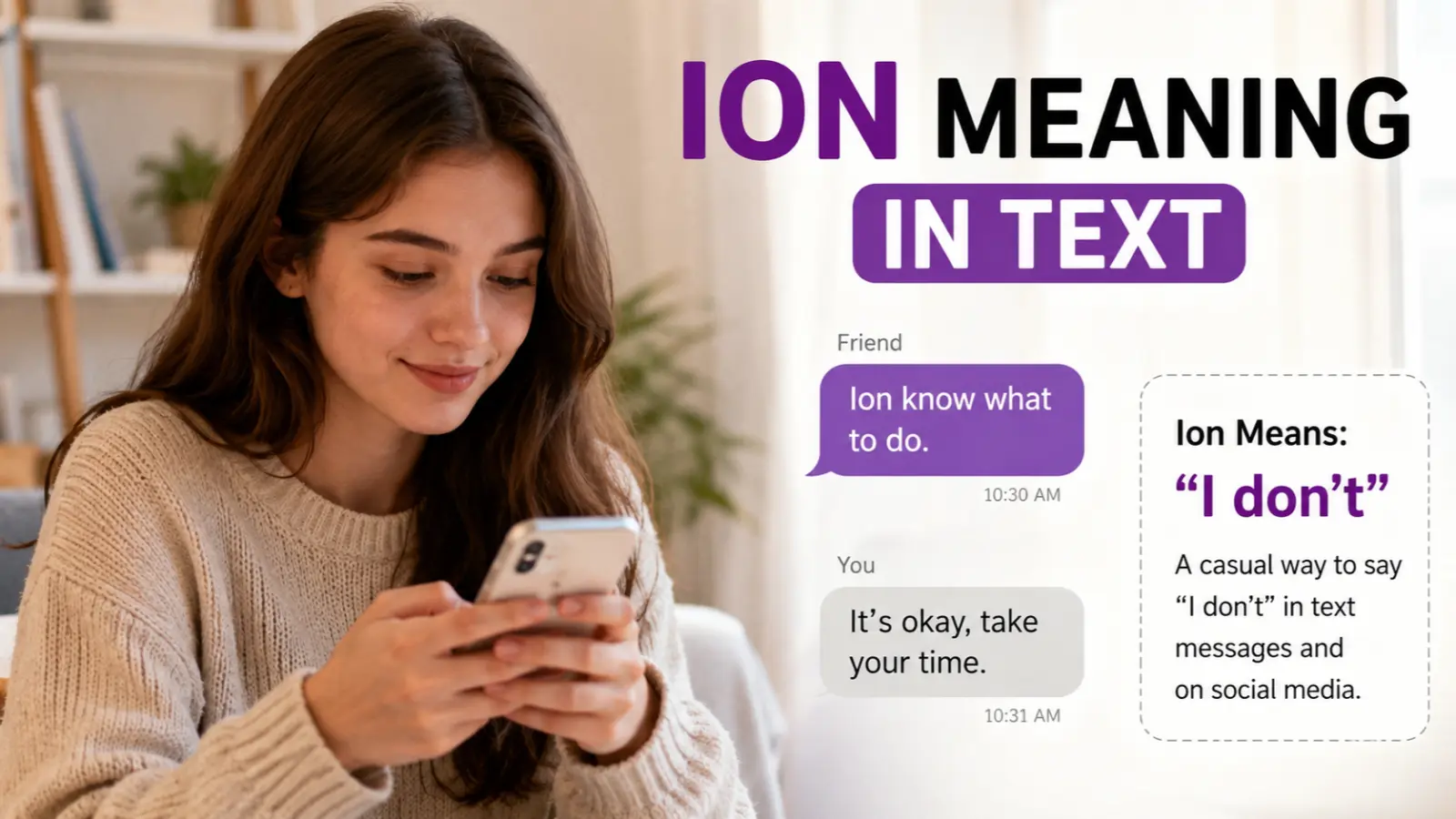
Ion meaning in text is a popular internet slang term that often confuses people who see it in text messages, TikTok comments, Snapchat, Instagram, or X (formerly Twitter).
If you’ve received a message like “Ion know” or “Ion care”, you may wonder whether it refers to science or something entirely different.
The good news is that in texting, “ion” has nothing to do with chemistry. Instead, it is a casual slang expression used in everyday online conversations.
Understanding its meaning can help you avoid misunderstandings and communicate more naturally on social media.
This guide explains what ion meaning in text is, where it came from, how people use it, and when it is appropriate to use.
Quick Answer
In texting, “ion” simply means “I don’t.” It is an informal slang spelling that represents how many people naturally pronounce “I don’t” in casual speech.
Example:
Friend: “Ion think that’s a good idea.”
Meaning: “I don’t think that’s a good idea.”
What Does Ion Mean in Text?
The ion meaning in text is “I don’t.”
Instead of typing I don’t, many people shorten it to ion because it is faster and reflects casual pronunciation.
Examples include:
- Ion know.
- Ion care.
- Ion remember.
- Ion want to go.
- Ion think so.
This slang is especially common among younger internet users and on social media platforms.
Ion Full Form
Many people search for ion full form, but technically ion is not an acronym.
It does not stand for multiple words where each letter has a separate meaning.
Instead:
- Ion = I don’t
So if someone asks, “What does ion stand for?”, the answer is simply:
It represents the phrase “I don’t.”
Ion Meaning in Different Contexts
The meaning stays almost the same across platforms, but the context changes.
In Text Messages
Friends often use it to type quickly.
Example:
- “Ion know what happened.”
Meaning:
- “I don’t know what happened.”
On Snapchat
Snapchat conversations are usually casual, making “ion” very common.
Example:
- “Ion got time today.”
Meaning:
- “I don’t have time today.”
On TikTok
TikTok comments frequently include this slang.
Example:
- “Ion believe this.”
Meaning:
- “I don’t believe this.”
On Instagram
People use it in comments and captions.
Example:
- “Ion miss those days.”
Meaning:
- “I don’t miss those days.”
On X (Twitter)
Because of character limits and fast conversations, users often shorten words.
Example:
- “Ion agree.”
Meaning:
- “I don’t agree.”
Is Ion Rude, Offensive, or Neutral?
Generally, ion is neutral.
It is not considered offensive by itself.
However, the sentence around it determines the tone.
Friendly
- “Ion forgot your birthday.”
Casual
- “Ion know lol.”
Slightly Rude
- “Ion care.”
Argumentative
- “Ion believe anything you say.”
The slang itself isn’t rude, but the message can sound dismissive depending on how it’s used.
Where Is Ion Commonly Used?
You’ll mostly find ion in informal conversations.
Popular places include:
- SMS texting
- Snapchat
- TikTok
- Discord
- X (Twitter)
- Online gaming chats
- Group chats
- YouTube comments
It is rarely used in formal communication.
Real-Life Conversation Examples
Friendly
Alex: Are you coming tonight?
Jordan: Ion know yet. I’ll let you know later.
Casual
Friend: Did you watch the game?
You: Ion watch sports much.
Argumentative
Person A: You’re wrong.
Person B: Ion think so.
Funny
Friend: Want to wake up at 6 AM?
You: Ion even wake up before 10.
Relationship
Partner: Are you upset?
You: Ion wanna argue.
Emotional and Psychological Meaning
Although ion simply means I don’t, it can also reflect emotions depending on context.
It may express:
- Uncertainty
- Frustration
- Disinterest
- Confidence
- Relaxed conversation
- Sarcasm
- Humor
For example:
“Ion care.”
This may suggest:
- Emotional distance
- Confidence
- Anger
- Indifference
Always consider the surrounding conversation before interpreting the speaker’s feelings.
Origin and Background of Ion
The texting version of ion developed from spoken English.
Many English speakers naturally pronounce:
“I don’t”
as something close to:
“Ion”
Over time, internet users began spelling it exactly how it sounded.
The slang became especially popular through:
- African American Vernacular English (AAVE)
- Hip-hop culture
- Social media
- Meme culture
- TikTok
- Online messaging
Today, millions of people use it daily in casual conversations.
Comparison with Similar Slang
| Slang | Meaning | Example |
|---|---|---|
| Ion | I don’t | Ion know |
| IDK | I don’t know | IDK what happened |
| IDC | I don’t care | IDC anymore |
| IMO | In my opinion | IMO it’s better |
| NGL | Not gonna lie | NGL that’s funny |
| FR | For real | FR that’s true |
Unlike IDK, ion can replace I don’t in many different sentences.
When to Avoid Using Ion
Avoid using ion in professional situations.
Examples include:
- Job applications
- Business emails
- School assignments
- Academic writing
- Customer support
- Legal documents
Instead, write the complete phrase:
“I don’t.”
When to Use Ion
It works well in relaxed conversations.
Use it when chatting with:
- Friends
- Classmates
- Siblings
- Gaming partners
- Social media followers
It sounds natural in informal settings.
Polite Alternatives
If you want to sound more respectful or professional, try these instead:
- I don’t think so.
- I don’t know.
- I’m not sure.
- I don’t agree.
- I don’t believe that’s correct.
- I don’t have enough information.
These alternatives are clearer and suitable for formal conversations.
Why Do People Use Ion?
People prefer ion because it is:
- Faster to type
- Easier in casual chats
- Popular on social media
- Trendy among younger users
- Similar to everyday pronunciation
- Part of internet culture
Using slang can also help people feel more connected within online communities.
Impact of Using Slang in Communication
Slang like ion has both advantages and disadvantages.
Benefits
- Makes conversations quicker
- Sounds natural
- Builds friendships
- Reflects modern internet culture
- Saves typing time
Drawbacks
- Can confuse older readers
- Not suitable for formal writing
- May appear unprofessional
- Can cause misunderstandings if the reader is unfamiliar with the slang
The best approach is to match your language to your audience.
Is Ion Safe for Social Media?
Yes.
The ion meaning in text is generally safe on:
- TikTok
- Snapchat
- X (Twitter)
- Discord
Since it simply means “I don’t,” it does not violate community guidelines or contain offensive language.
However, remember that the rest of the sentence still matters.
For example:
- “Ion know.” ✔️ Neutral
- “Ion care about anyone.” ⚠️ May sound insensitive
Common Misunderstandings
Some people mistakenly believe:
Ion means a scientific ion.
In chemistry, an ion is a charged atom or molecule.
In texting, ion has a completely different meaning.
Ion is an acronym.
It is not.
It is simply a shortened spelling of “I don’t.”
Ion is rude.
Not necessarily.
The surrounding sentence determines whether it sounds friendly or disrespectful.
Variations and Types
You may see similar expressions online:
- Ion know
- Ion care
- Ion think so
- Ion remember
- Ion wanna
- Ion got time
- Ion even
All of these replace “I don’t” with “ion.”
How to Respond When Someone Uses Ion
The best response depends on the conversation.
Examples:
Message: “Ion know.”
Response:
- “That’s okay.”
Message: “Ion think so.”
Response:
- “Why not?”
Message: “Ion care.”
Response:
- “No worries.”
Understanding the context helps you reply appropriately.
Regional and Cultural Usage
The slang ion is especially common in:
- United States
- Online gaming communities
- TikTok culture
- Hip-hop communities
- African American Vernacular English (AAVE)
- Youth texting culture
Although people worldwide now use it, it remains most popular in American internet slang.
Frequently Asked Questions (FAQs)
What does ion mean in text?
It means “I don’t.” It is an informal internet slang used in texting and social media.
What does ion stand for?
It does not officially stand for separate words. It is simply a shortened spelling of “I don’t.”
Is ion a bad word?
No. It is generally neutral and not offensive. Its tone depends on the sentence.
Is ion used only on TikTok?
No. It is also widely used on Snapchat, Instagram, Discord, X (Twitter), YouTube, and regular text messages.
Does ion mean the same as IDK?
No.
IDK means “I don’t know,” while ion simply means “I don’t.”
Can I use ion in school or work?
It’s better not to. Use the full phrase “I don’t” in formal or professional communication.
Conclusion
The ion meaning in text is simple once you know it. In modern internet slang, ion means “I don’t,” making it a quick and casual way to communicate in text messages and on social media.
While it is perfectly acceptable among friends and in informal online conversations, it should be avoided in professional emails, school assignments, and business communication. Understanding the context is important because the tone of the message, not the slang itself determines whether it sounds friendly, neutral, or dismissive.
Now that you know what does ion stand for, its usage, origin, examples, and alternatives, you’ll be able to recognize and use this popular slang naturally in everyday digital conversations.