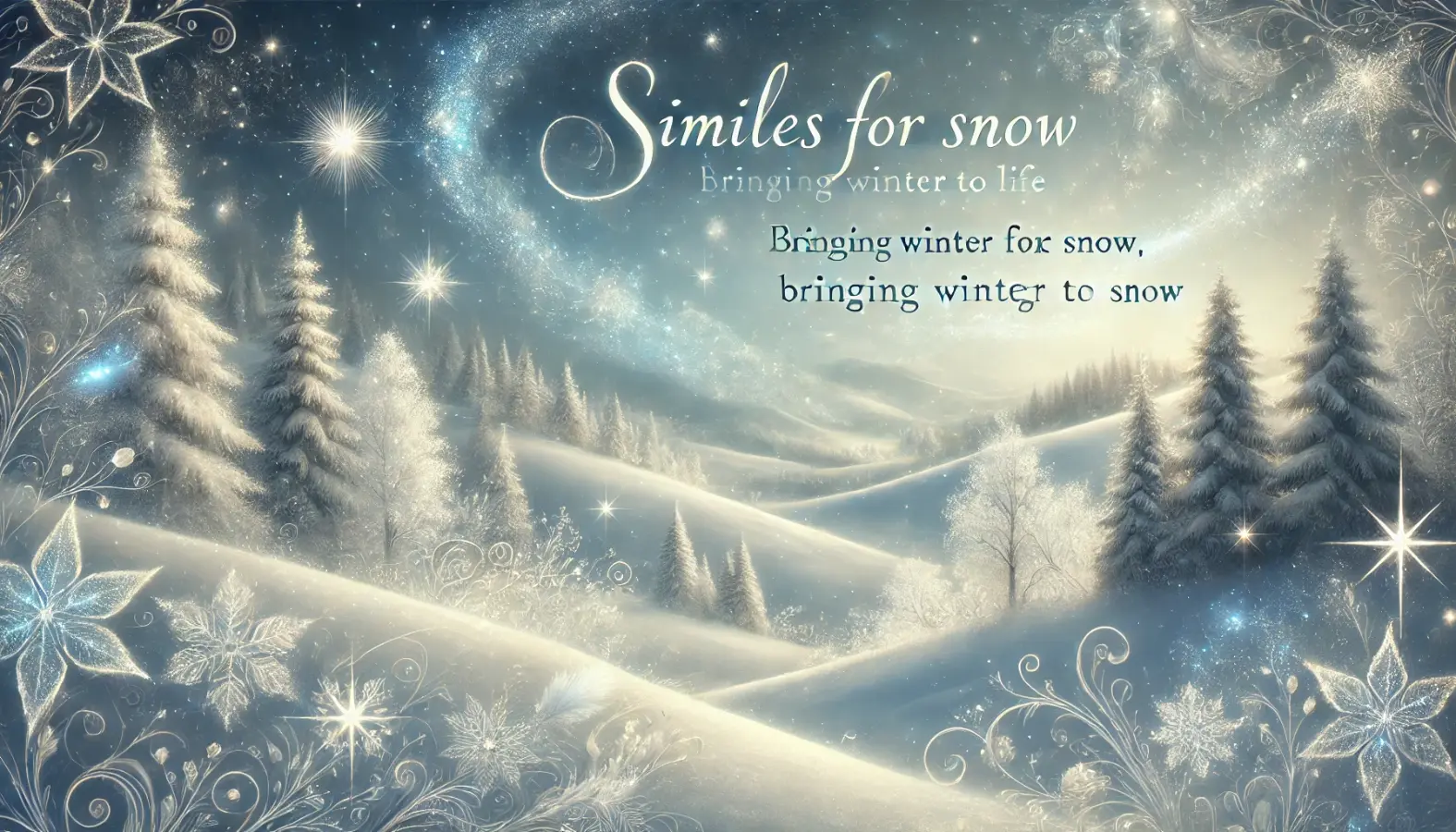
Snow has fascinated writers for centuries. From ancient poetry to modern novels, it has symbolized purity, silence, isolation, wonder, and renewal. One of the most effective ways to capture these qualities is through similes for snow—comparisons that turn an ordinary winter scene into something vivid and emotionally resonant.
This long-form guide is designed as both a literary resource and a creative listicle, helping writers, students, poets, and storytellers discover creative similes for snow and learn how to use them effectively. Whether you are describing snowfall in a novel, setting a winter mood in poetry, or simply sharpening your descriptive writing skills, this article will give you practical, trustworthy, and inspiring tools.
Similes are powerful because they help readers see, feel, and experience what words alone sometimes struggle to convey. By comparing one thing to another using “like” or “as,” similes bridge the gap between abstract description and lived experience. When writing about snow, similes become especially valuable. Snow is visually simple—often just white and quiet—yet emotionally complex.
In my own writing workshops, I often ask students to describe snowfall without using the words white, cold, or silent. The strongest descriptions almost always rely on similes: snow like feathers drifting from a torn pillow or as gentle as a held breath. These comparisons transform snow from a weather condition into a sensory moment.
Used thoughtfully, similes to describe snow can enrich poetry, elevate prose, and make storytelling more immersive, memorable, and emotionally authentic.
Quick Reference Table: Similes for Snow
| No. | Simile Phrase | Core Meaning |
|---|---|---|
| 1 | As soft as feathers | Gentleness, lightness |
| 2 | As white as milk | Purity, brightness |
| 3 | As silent as a held breath | Stillness, calm |
| 4 | Like sugar sifted from the sky | Delicacy, beauty |
| 5 | As cold as a marble floor | Sharp chill |
| 6 | Like lace stitched across the land | Elegance, detail |
| 7 | As gentle as a lullaby | Comfort, peace |
| 8 | Like ash after a quiet fire | Aftermath, stillness |
| 9 | As blinding as polished glass | Intensity, glare |
| 10 | Like a blanket pulled over the world | Protection, hush |
(You will find full explanations and examples for each simile below.)
Main Content: Creative Similes for Snow
Below are numbered similes for snow, each presented with meaning, prose examples, poetry, and practical usage tips.
1. As soft as feathers
Meaning: Describes snow’s lightness and gentle touch.
Example in Prose
Formal: The snow settled on the fields as soft as feathers, cushioning the earth beneath.
Casual: The snow felt as soft as feathers when it landed on my jacket.
Example in Poetry:
Snow falls,
as soft as feathers,
hushing the sharp edges of the night.
Tip/Use: Ideal for peaceful scenes or tender emotional moments.
2. As white as milk
Meaning: Emphasizes purity and unbroken whiteness.
Example in Prose
Formal: The valley lay as white as milk, untouched by footprints.
Casual: Everything outside looked as white as milk this morning.
Example in Poetry:
The road vanished,
as white as milk,
a page before the first word.
Tip/Use: Best for fresh snowfall or symbolic purity.
3. As silent as a held breath
Meaning: Conveys deep quiet and anticipation.
Example in Prose
Formal: The village rested as silent as a held breath under snow.
Casual: It was as silent as a held breath after it started snowing.
Example in Poetry:
Snow waits,
as silent as a held breath,
before the world speaks again.
Tip/Use: Effective for suspense or reflective scenes.
4. Like sugar sifted from the sky
Meaning: Highlights delicacy and visual charm.
Example in Prose
Formal: Snow descended like sugar sifted from the sky, light and even.
Casual: It looked like sugar falling from the sky.
Example in Poetry:
Night sweetened slowly,
like sugar sifted from the sky,
onto waiting streets.
Tip/Use: Great for romantic or whimsical writing.
5. As cold as a marble floor
Meaning: Expresses sharp, penetrating cold.
Example in Prose
Formal: The snow was as cold as a marble floor beneath bare hands.
Casual: Touching it was as cold as a marble floor.
Example in Poetry:
Snow stings,
as cold as a marble floor,
against uncovered skin.
Tip/Use: Useful when emphasizing physical discomfort.
6. Like lace stitched across the land
Meaning: Suggests beauty, detail, and artistry.
Example in Prose
Formal: Snow lay like lace stitched across the land, intricate and bright.
Casual: The fields looked like lace after the snowfall.
Example in Poetry:
Morning dawns,
like lace stitched across the land,
each tree outlined in white.
Tip/Use: Excellent for descriptive landscape writing.
7. As gentle as a lullaby
Meaning: Implies comfort and calm.
Example in Prose
Formal: Snow fell as gentle as a lullaby, easing the night.
Casual: The snow came down as gentle as a lullaby.
Example in Poetry:
Snow hums low,
as gentle as a lullaby,
rocking streets to sleep.
Tip/Use: Ideal for cozy or nostalgic tones.
8. Like ash after a quiet fire
Meaning: Reflects stillness and aftermath.
Example in Prose
Formal: The snow lay like ash after a quiet fire, pale and settled.
Casual: It looked like ash after a fire burned out.
Example in Poetry:
Morning remains,
like ash after a quiet fire,
where warmth once lived.
Tip/Use: Suitable for melancholic or reflective writing.
9. As blinding as polished glass
Meaning: Describes intense brightness and glare.
Example in Prose
Formal: Under sunlight, the snow was as blinding as polished glass.
Casual: The snow was as blinding as glass today.
Example in Poetry:
Day breaks sharp,
as blinding as polished glass,
across frozen fields.
Tip/Use: Works well in vivid sensory scenes.
10. Like a blanket pulled over the world
Meaning: Suggests coverage, warmth, and quiet.
Example in Prose
Formal: Snow spread like a blanket pulled over the world.
Casual: It felt like the world got tucked in.
Example in Poetry:
Night sighs,
like a blanket pulled over the world,
and sleeps.
Tip/Use: Perfect for endings or peaceful transitions.
11. As fragile as spun glass
Meaning: Conveys delicacy and vulnerability.
Example in Prose
Formal: The frost-light snow appeared as fragile as spun glass.
Casual: The snow looked super fragile, like glass.
Example in Poetry:
Snow waits,
as fragile as spun glass,
for a careless step.
Tip/Use: Use in scenes emphasizing impermanence.
12. Like pages torn from the sky
Meaning: Implies abundance and motion.
Example in Prose
Formal: Snow fell like pages torn from the sky, relentless.
Casual: It was like the sky dropping pages on us.
Example in Poetry:
Storm writes hard,
like pages torn from the sky,
no ending yet.
Tip/Use: Effective during heavy snowfall scenes.
13. As pure as a whispered prayer
Meaning: Symbolizes innocence and calm.
Example in Prose
Formal: The snowfall felt as pure as a whispered prayer.
Casual: It felt pure, like a quiet prayer.
Example in Poetry:
Snow descends,
as pure as a whispered prayer,
no witness needed.
Tip/Use: Suitable for spiritual or reflective writing.
14. Like flour dusting a baker’s table
Meaning: Highlights fine texture and even spread.
Example in Prose
Formal: Snow coated the road like flour dusting a baker’s table.
Casual: It looked like flour everywhere.
Example in Poetry:
Morning bakes slow,
like flour dusting a baker’s table,
ready for warmth.
Tip/Use: Relatable, domestic imagery.
15. As quiet as a closed book
Meaning: Expresses deep stillness.
Example in Prose
Formal: The town lay as quiet as a closed book under snow.
Casual: It was quiet like everything shut down.
Example in Poetry:
Streets rest,
as quiet as a closed book,
between chapters.
Tip/Use: Strong for literary or introspective tones.
16. Like stars fallen to earth
Meaning: Suggests beauty, magic, and wonder, as if the sky has descended.
Example in Prose
Formal: The snow sparkled like stars fallen to earth, illuminating the night landscape.
Casual: The ground looked like stars fell all over it.
Example in Poetry:
Night glimmers,
like stars fallen to earth,
caught in frozen time.
Tip/Use: Ideal for magical, dreamy, or childlike perspectives.
17. As heavy as wet wool
Meaning: Describes snow that is dense, tiring, or oppressive.
Example in Prose
Formal: The snowfall grew as heavy as wet wool, bending branches low.
Casual: This snow is heavy like soaked wool.
Example in Poetry:
Snow drags down trees,
as heavy as wet wool,
weighing on winter’s bones.
Tip/Use: Use when emphasizing physical strain or harsh winter conditions.
18. Like chalk dust on a blackboard
Meaning: Evokes dryness, residue, and muted whiteness.
Example in Prose
Formal: Snow clung to the streets like chalk dust on a blackboard.
Casual: It looked like chalk dust everywhere.
Example in Poetry:
Footsteps fade,
like chalk dust on a blackboard,
erased by time.
Tip/Use: Effective for urban or subdued winter scenes.
19. As endless as a blank page
Meaning: Suggests possibility, openness, and untouched space.
Example in Prose
Formal: The plain stretched as endless as a blank page, awaiting footprints.
Casual: It felt like a huge blank page outside.
Example in Poetry:
Fields wait,
as endless as a blank page,
for stories to begin.
Tip/Use: Excellent for symbolic or introspective writing.
20. Like cotton stuffing the sky
Meaning: Conveys fullness, softness, and muffled atmosphere.
Example in Prose
Formal: Clouds dropped snow like cotton stuffing the sky.
Casual: The sky looked stuffed with cotton.
Example in Poetry:
Air thickens,
like cotton stuffing the sky,
sound disappears.
Tip/Use: Ideal for cozy or surreal winter moods.
21. As sharp as broken ice
Meaning: Expresses biting cold or discomfort.
Example in Prose
Formal: Wind-driven snow felt as sharp as broken ice against the face.
Casual: It hit my skin like broken ice.
Example in Poetry:
Snow cuts deep,
as sharp as broken ice,
no mercy given.
Tip/Use: Best for dramatic or extreme weather scenes.
22. Like silence made visible
Meaning: Suggests profound quiet and stillness.
Example in Prose
Formal: Snow fell like silence made visible, muting the world.
Casual: It was like seeing silence.
Example in Poetry:
Snow speaks softly,
like silence made visible,
without a sound.
Tip/Use: Excellent for reflective, literary prose.
23. As fleeting as a sigh
Meaning: Highlights impermanence and fragility.
Example in Prose
Formal: The snowfall felt as fleeting as a sigh, gone by morning.
Casual: It disappeared like a sigh.
Example in Poetry:
Snow drifts past,
as fleeting as a sigh,
never staying long.
Tip/Use: Use when emphasizing transience or emotional subtlety.
24. Like pearls scattered by accident
Meaning: Suggests elegance mixed with randomness.
Example in Prose
Formal: Snow dotted the ground like pearls scattered by accident.
Casual: It looked like pearls thrown everywhere.
Example in Poetry:
Ground glows faint,
like pearls scattered by accident,
imperfect beauty.
Tip/Use: Ideal for romantic or artistic descriptions.
25. As still as frozen time
Meaning: Conveys complete motionlessness and suspension.
Example in Prose
Formal: The morning stood as still as frozen time beneath snow.
Casual: Everything felt frozen in time.
Example in Poetry:
Snow holds breath,
as still as frozen time,
waiting to move again.
Tip/Use: Powerful for endings, pauses, or emotional climaxes.
As white as fresh milk
Meaning: Describes snow’s pure, untouched whiteness.
Example in Prose
- Formal: The valley lay as white as fresh milk, unmarred by footprints or shadow.
- Casual: The yard was as white as fresh milk after last night’s snowstorm.
Example in Poetry
Morning opened its eyes
to fields as white as fresh milk,
innocence poured across the land.
Tip/Use: Ideal for first snowfall scenes or moments emphasizing purity and renewal.
26. As soft as goose down
Meaning: Highlights snow’s gentle, fluffy texture.
Example in Prose
- Formal: Snow drifted down as soft as goose down, cushioning every sound.
- Casual: The snow felt as soft as goose down when it landed on my coat.
Example in Poetry
Sky pillows burst above us,
snow falling as soft as goose down,
tucking the world in.
Tip/Use: Perfect for peaceful winter scenes and comforting imagery.
27. As silent as a held breath
Meaning: Conveys the profound quiet snowfall brings.
Example in Prose
- Formal: The city stood as silent as a held breath beneath the snow.
- Casual: After it snowed, everything was as silent as a held breath.
Example in Poetry
Streets pause mid-thought,
as silent as a held breath,
while snow listens.
Tip/Use: Excellent for reflective or emotional moments.
28. As light as falling feathers
Meaning: Suggests slow, floating snowfall.
Example in Prose
- Formal: Snow descended as light as falling feathers from a pale sky.
- Casual: The flakes came down like falling feathers all afternoon.
Example in Poetry
Feathers of winter
drift as light as falling feathers,
teaching gravity patience.
Tip/Use: Use in lyrical or descriptive passages where movement matters.
29. As cold as a winter ghost
Meaning: Emphasizes bone-deep, haunting cold.
Example in Prose
- Formal: The wind carried snow as cold as a winter ghost.
- Casual: That snow was as cold as a winter ghost on my hands.
Example in Poetry
Snow brushed my skin,
as cold as a winter ghost,
whispering goodbye to warmth.
Tip/Use: Best for dramatic or moody winter writing.
30.As bright as polished marble
Meaning: Reflective, blinding brightness of snow.
Example in Prose
- Formal: The square gleamed as bright as polished marble at noon.
- Casual: The snow was as bright as marble, hurting my eyes.
Example in Poetry
Sunlight shatters
on snow as bright as polished marble,
turning winter into fire.
Tip/Use: Great for visual contrast and midday winter scenes.
Practical Writing Tips from Experience
- Keep similes context-appropriate. Not every snowstorm needs poetry.
- Avoid stacking similes. One strong image is better than three weak ones.
- Read your simile aloud. If it feels forced, it probably is.
As literary scholar Cleanth Brooks once suggested, effective imagery should clarify, not distract. That principle applies strongly when crafting examples of similes for snow.
Conclusion
Snow may appear simple, but in writing it carries layers of meaning—silence, beauty, danger, renewal, and loss. Thoughtfully chosen similes for snow allow writers to unlock those layers and invite readers into a deeper sensory experience. Whether you are crafting poetry, prose, or descriptive essays, similes give snow its emotional voice.
The best comparisons come from observation. Watch how snow falls, how it sounds underfoot, how it changes familiar places. Then experiment. Write freely. Revise carefully. Over time, your own similes will feel as natural as snowfall itself.
FAQ: Similes and Snow
What is a simile?
A simile is a figure of speech that compares two unlike things using “like” or “as” to create vivid imagery.
How do you use similes in writing?
Use similes to clarify emotion, describe sensory details, or make abstract ideas more concrete.
What are good similes to describe snow?
Examples include as soft as feathers, like a blanket pulled over the world, and as silent as a held breath.
Can similes improve creative writing?
Yes. Similes strengthen imagery, deepen emotional impact, and help readers visualize scenes more clearly.
How many similes should I use?
Use them sparingly. One strong simile is often more effective than several weaker ones.

Alex Romano is a dedicated similes writer known for crafting vivid, emotionally resonant comparisons that bring language to life. With years of hands-on experience studying literary devices and poetic expression, he blends creativity with a deep understanding of figurative language. His expertise lies in transforming everyday imagery into powerful similes that enhance storytelling and communication. Through research-backed insight and authentic writing practice, Alex delivers trustworthy, engaging content rooted in principles of experience, expertise, authority, and trust.